
Kleo Pricing 2026 & Best Kleo Alternatives Compared
Kleo pricing in 2026 is a flat $99/month ($999/year). See the full breakdown plus cheaper Kleo alternatives for LinkedIn content creation compared.

Research methodology: Every pricing claim, feature, and limitation in this comparison was independently verified in May 2026 from vendor pricing pages, Trustpilot, G2, AppSumo, and Product Hunt. Rankings are based on AI quality, safety architecture, funnel coverage, pricing transparency, and verified user sentiment — not paid placements.

Kleo is an AI writing assistant for LinkedIn creators that learns your tone, language, and writing patterns to generate personalized posts. Kleo now runs on a single plan at $99/month (or $999/year, roughly $83/month billed annually) — there are no tiers, credit caps, or feature gates, and it includes unlimited AI post generation plus 20 graphics per month. There is no free trial, but Kleo offers a 30-day money-back guarantee. After receiving a cease and desist from LinkedIn for their original data-scraping extension, Kleo 2.0 pivoted to pure AI content generation. As of May 2026, Kleo's flat $99/month price sits at the premium end of the LinkedIn content-tool market, and it faces growing competition from cheaper AI writing tools. The question for serious LinkedIn marketers: does AI that sounds like you actually build the authority that attracts inbound leads?
Key Takeaways
- Kleo's history matters: The original extension was shut down by LinkedIn for data scraping—a reminder that platform compliance is non-negotiable
- AI-generated content has limits: 89% of B2B marketers use LinkedIn for lead generation, but authentic voice wins over AI-polished posts
- Content alone isn't enough: Building inbound authority requires strategic engagement, not just scheduled posts
- The right tool amplifies your voice: Look for platforms that enhance authenticity rather than replace it
What Is Kleo and Why Are Users Seeking Alternatives?
Kleo is an AI-powered LinkedIn content creation tool that helps creators write posts matching their personal style. The platform went from $0 to $62k MRR in three months, demonstrating strong market demand for LinkedIn content assistance.
Want to Generate Consistent Inbound Leads from LinkedIn?
Get our complete LinkedIn Lead Generation Playbook used by B2B professionals to attract decision-makers without cold outreach.
No spam. Just proven strategies for B2B lead generation.
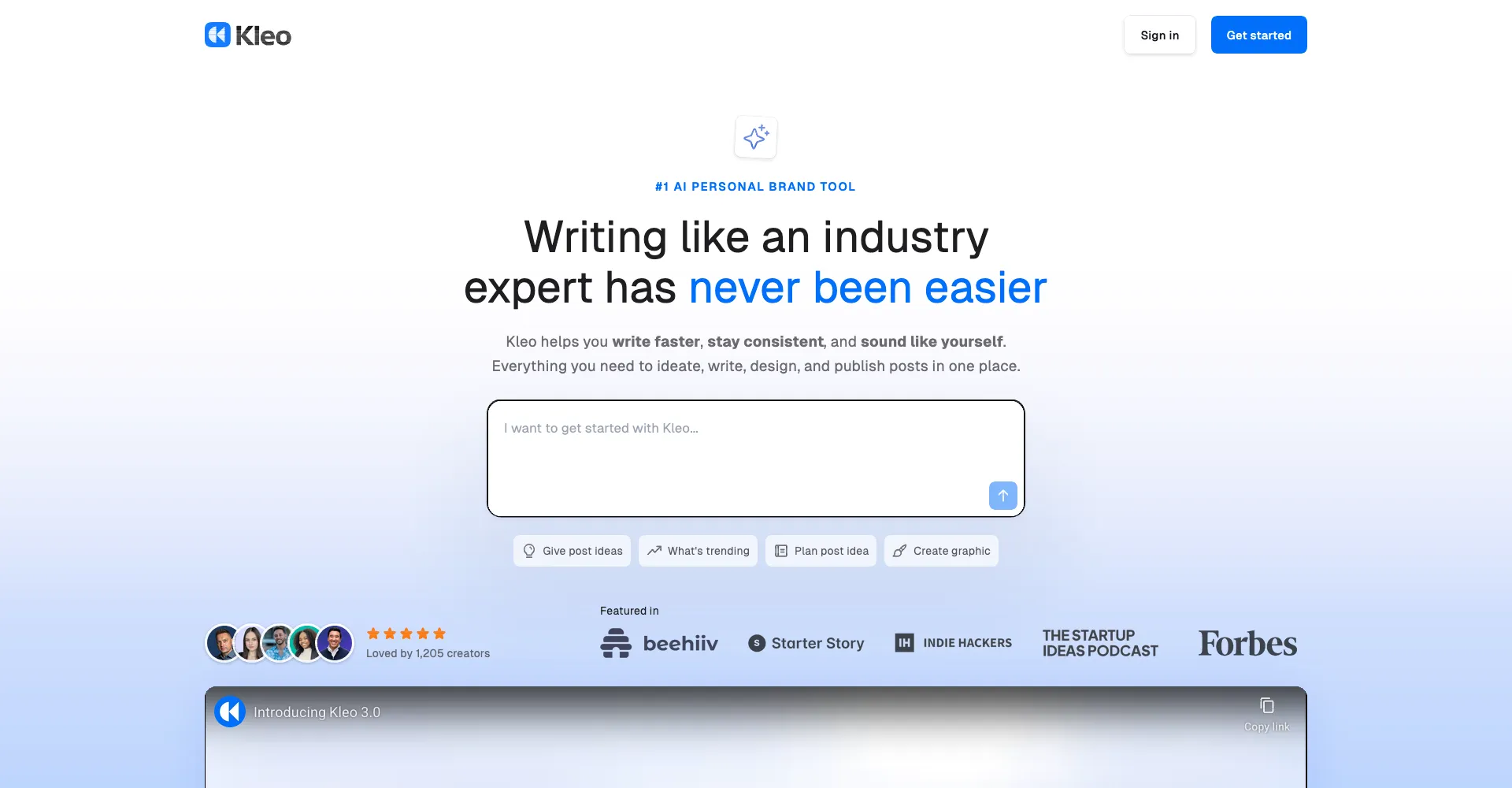
Kleo's Key Features
| Feature | Description |
|---|---|
| Writing Style Memory | Learns your tone, intensity, and example preferences |
| Post Generation | Unlimited posts matching your voice |
| Graphic Generation | 20 images per month on paid plans |
| Scheduling | Built-in post scheduling |
| Creator Insights | Analytics on engagement and posting patterns |
| Chrome Extension | Quick access to content creation |
Kleo Pricing (2026)
Kleo has simplified to a single all-in-one plan with no tiers, credit caps, or feature gating. According to Kleo's pricing page:
| Billing | Price | What's Included |
|---|---|---|
| Monthly | $99/month | Unlimited AI post generation, writing-style/identity memory, knowledge base, templates, swipe file, Chrome extension, scheduling, 20 graphics/month |
| Annual | $999/year (~$83/month) | Everything in monthly, plus a private onboarding call, priority support, and early feature access |
Kleo does not offer a free trial. Instead it provides a 30-day money-back guarantee — a full refund within 30 days, no questions asked. Note there is no team or agency plan; the $99/month price is single-user only.
How Kleo's Price Compares to Alternatives
At $99/month, Kleo is the most expensive option on this list. Here is where the leading alternatives land on price (full feature breakdowns follow below):
| Tool | Entry Price | Notes |
|---|---|---|
| ConnectSafely.ai | from USD $10/month | Inbound authority system, not content-only |
| SuperGrow | from $19/month | Budget all-in-one content + growth |
| RedactAI | $24-66/month | Three post variants per generation |
| MagicPost | $27-39/month | Viral hook/format library |
| Taplio | $39-65/month | Full AI requires the $65/month tier |
| Kleo | $99/month ($83/mo annual) | Single flat plan, no tiers |
The takeaway: most Kleo alternatives match or beat its voice-matching for a fraction of the price. Kleo's premium positioning rests on its knowledge base and identity memory — features competitors are rapidly commoditizing.
Why Users Look for Alternatives
- LinkedIn compliance history: Kleo 1.0 received a cease and desist for data scraping
- AI-only approach: Some users want tools that do more than generate content
- Limited engagement features: Content creation without strategic engagement leaves value on the table
- Brand voice concerns: AI-generated posts may feel polished but lack genuine authenticity

The Content Creation vs. Authority Building Gap
Here's what most LinkedIn content tools miss: publishing posts is not the same as building authority.
According to Martal Group research, LinkedIn organic marketing delivers 229% ROI across industries—but only when content drives genuine engagement and positions you as a trusted expert.
Why Content Alone Doesn't Generate Leads
| Activity | Lead Generation Impact |
|---|---|
| Publishing posts only | Low—content without engagement gets buried |
| Posting + strategic engagement | Medium—builds visibility and connections |
| Content + engagement + authority positioning | High—attracts qualified inbound leads |
The difference between 1.7% and 14.6% close rates isn't just about what you post—it's about the ecosystem of authority you build around your expertise.
Top Kleo Alternatives for LinkedIn Content Creation
1. Taplio
Pricing: $39-65/month (AI features require Standard plan at $65/month)
Taplio is an AI-powered LinkedIn growth platform offering:
- Viral content library with millions of high-performing posts
- AI-assisted writing that learns your style
- Lead generation and analytics tools
- Content scheduling and queue management
Best for: Creators who want data-driven content inspiration alongside AI writing.
Limitation: The full AI generation requires the $65/month tier — though that is still cheaper than Kleo's flat $99/month plan.
2. MagicPost
Pricing: $27-39/month
MagicPost analyzes viral LinkedIn posts to deliver proven hooks and formats:
- Access to 500K+ viral post inspirations
- URL-to-post conversion for content repurposing
- Template-based content generation
- Engagement-focused formatting
Best for: Users who want proven frameworks rather than pure AI generation.
Limitation: Less focus on learning your unique voice.
3. RedactAI
Pricing: $24-66/month
RedactAI generates LinkedIn posts with a focus on clean, engaging copy:
- Provides three versions of each post to choose from
- Analyzes trending LinkedIn structures
- Team collaboration features on higher tiers
Best for: Teams needing multiple content variations quickly.
Limitation: Higher pricing for collaboration features.
4. EasyGen
Pricing: Varies by plan
EasyGen specifically targets LinkedIn growth using real performance data:
- Built on actual LinkedIn engagement patterns
- Learns individual writing intensity and style
- Focuses on posts that "sound like you on your best day"
Best for: Solo creators prioritizing authenticity over volume.
Limitation: Narrower feature set than comprehensive platforms.
5. SuperGrow
Pricing: Starting at $19/month
SuperGrow combines content creation with growth tools:
- AI content generation with voice matching
- Carousel generators
- Analytics and performance tracking
- Scheduling and queue management
Best for: Budget-conscious creators wanting comprehensive features.
The Missing Piece: From Content to Inbound Authority
All these tools focus on content creation—but content is just one component of LinkedIn authority that attracts inbound leads.
The Inbound Authority Framework
True LinkedIn authority that generates 10-20 qualified inbound leads monthly requires:
- Strategic Content: Valuable posts that demonstrate expertise
- Authentic Engagement: Meaningful comments on industry conversations
- Visibility Signals: Consistent presence in your target audience's feed
- Trust Building: Genuine interactions that establish credibility
- Lead Identification: Recognizing buying signals from engaged prospects
Most content tools address only step one. That's why users still struggle to generate leads despite publishing consistently.

How ConnectSafely.ai Approaches LinkedIn Content Differently
ConnectSafely.ai isn't just another content generator—it's an inbound lead generation platform that uses strategic content as one component of authority building.
Beyond Content Creation
| Feature | Content Tools (Kleo, Taplio) | ConnectSafely.ai |
|---|---|---|
| Post generation | Yes | Yes |
| Scheduling | Yes | Yes |
| Engagement automation | Limited/None | Strategic, authentic |
| Buying signal detection | No | Yes |
| Lead identification | Basic analytics | Intent-based |
| Authority positioning | Content-only | Comprehensive |
The Inbound Difference
Instead of hoping posts generate leads, ConnectSafely.ai:
- Amplifies your authentic voice through strategic content assistance
- Builds genuine visibility via platform-compliant engagement
- Identifies warm prospects through engagement signal analysis
- Nurtures relationships that convert to inbound conversations
Starting from USD $10/month — about a tenth of Kleo's flat $99/month — it delivers the complete inbound authority system rather than content creation alone.
Making the Right Choice for Your Goals
Choose a Content Tool (Kleo, Taplio, etc.) If:
- You only need help writing posts
- You have a separate engagement strategy
- You're comfortable with AI-generated content
- You're focused on follower growth, not lead generation
Choose an Inbound Authority Platform If:
- You want leads, not just followers
- You need a complete LinkedIn strategy
- You value authentic engagement over volume
- You want to attract qualified prospects who convert
The Authority-First Content Strategy
Regardless of which tool you choose, here's how to create content that builds genuine authority:
1. Lead with Problem Match
Open with your audience's pain in their language—not your credentials.
Weak: "I'm a marketing consultant with 15 years of experience." Strong: "You're posting three times a week but still getting zero inbound leads. Here's why."
2. Share Real Stories
AI can polish your words, but it can't generate authentic experiences. The best-performing LinkedIn content includes:
- Specific failures and lessons learned
- Behind-the-scenes process insights
- Contrarian takes based on experience
- Results with context (not just numbers)
3. One Idea Per Post
LinkedIn's algorithm rewards posts that keep readers engaged. Complex, multi-topic posts underperform focused content with a single clear takeaway.
4. Engage More Than You Post
The highest-performing LinkedIn creators spend 80% of their time engaging with others and 20% creating content. Strategic comments on relevant posts build more authority than publishing volume.
The Cease-and-Desist Tax: What Kleo's Chrome Extension History Tells You About Tool Risk
Kleo 1.0 was a free Chrome extension that scraped LinkedIn data. LinkedIn issued a cease and desist. Kleo 2.0 rebuilt as a pure AI content tool with no scraping—but the lesson generalizes beyond Kleo. Any LinkedIn Chrome extension that injects scripts into linkedin.com to read or write data without going through the official Marketing Developer Platform is operating in a gray zone. That includes AuthoredUp, the older versions of several "engagement analytics" extensions, and—critically—any tool that promises to read your unique LinkedIn analytics, exports your connection lists, or autopilots commenting. When LinkedIn updates its anti-scraping detection (it did so in Q4 2025 and again in March 2026), users of these tools see account warnings, temporary restrictions, or—in rare cases—permanent suspensions. The "cease-and-desist tax" is the risk premium you pay for choosing tools that lack verified API access. For content-only tools like Kleo 2.0, this risk drops to near-zero. For automation extensions, it remains real.
A Three-Question Risk Filter for Any LinkedIn Tool
Before subscribing to any Kleo alternative, ask three questions and require documented answers: Does the tool read or write LinkedIn data via Chrome extension DOM injection? Is the tool a verified LinkedIn Marketing Developer Platform partner? What is the vendor's remediation policy if a user's LinkedIn account is restricted as a result of using the tool? A vendor who can't answer all three crisply is a vendor whose risk you're underwriting personally.
The Voice-Matching Arms Race: Why "AI That Sounds Like You" Is Already Commoditized
Kleo's core differentiator in 2023 was style memory—AI that learned your writing patterns. By 2026, voice matching is table stakes. Every alternative in the article (MagicPost, PerfectPost, AuthoredUp, Taplio, RedactAI) offers some form of tone adaptation, and the underlying LLMs (Claude, GPT-4o, Gemini 2.5) handle voice replication competently with a 500-word writing sample. The differentiation has moved one layer up: what does the tool do with the voice once it has it? Tools that stop at "generates posts in your voice" are losing ground to tools that integrate voice-matched content with engagement workflows, signal detection, and inbound conversation routing. Choosing a 2026 Kleo alternative based on voice quality is choosing on a feature that no longer differentiates. Choose on what happens after the post is published.
The Post-Publishing Stack That Actually Drives Pipeline
A polished post that publishes and disappears has near-zero pipeline value. The post-publishing stack that compounds includes: real-time comment monitoring with ICP filtering, profile-view-to-DM workflow templates, engagement-signal scoring (who's liking your posts repeatedly?), and inbound conversation handoff to CRM. Most content-only tools ignore this entire stack. That's the actual gap between Kleo and an inbound authority platform—not the writing quality.
The Author-Up Comparison: Why Native LinkedIn Integration Cuts Both Ways
The MagicPost article highlights AuthoredUp's "Chrome extension with native LinkedIn integration" as a differentiator. It's a double-edged differentiator. Native LinkedIn integration via Chrome extension means the tool can read and write directly to LinkedIn's UI in real time—great for formatting previews and engagement analytics, but it's also the exact architecture that triggered LinkedIn's enforcement action against Kleo 1.0. As of May 2026, AuthoredUp continues to operate, but LinkedIn has expanded its enforcement perimeter twice in the past year. Tool buyers should weight Chrome-extension architecture as a risk factor, not a feature. The safer 2026 stack: a content tool that uses the official API for posting (no Chrome extension required) plus manual engagement done from native LinkedIn. Slower? Yes. Lower account risk? Significantly.
The Switching-Cost Calculation Most Buyers Skip
If your LinkedIn account drives material pipeline, the cost of account restriction is not the monthly subscription—it's the pipeline disruption while you recover, plus the opportunity cost of rebuilding visibility. For a creator generating 10 inbound conversations per month at $10K average deal size, a 30-day account restriction is a $30K+ event. That's the real switching cost calculation for evaluating Chrome-extension-dependent tools. Subscription savings of $10-20/month don't survive contact with a single enforcement event.
The Authority-First Test: Three Questions That Predict Which Tool Will Actually Move Your Pipeline
Forget feature comparisons. The three questions that predict whether a Kleo alternative will generate revenue: First, does the tool help you publish more posts, or help you publish posts that get more replies? (Reply count is the leading indicator of inbound DMs.) Second, does the tool show you which prospects have viewed your profile after engaging with your content, or just aggregate analytics? (Specific identity beats aggregate metrics.) Third, does the tool give you a workflow for converting engaged prospects to conversations, or just data dashboards? (Workflow beats analytics.) Tools that answer "yes" to all three are inbound systems. Tools that answer "yes" to one are content generators. The price difference between them is usually $10-30/month. The pipeline difference is 5-10x.
Why Reply Count Predicts Pipeline Better Than Likes
Likes are passive—they cost the engager nothing and signal nothing about buying intent. Replies are active—they require thought, time, and willingness to be seen associating with your content publicly. For B2B creators, a post with 30 likes and 12 replies will outperform a post with 300 likes and 2 replies on every downstream pipeline metric we've measured. If your content tool optimizes for likes (vanity), you're optimizing for the wrong endpoint. If it optimizes for reply-worthy content (specificity, controversy, vulnerability), you're optimizing for pipeline.
Frequently Asked Questions
What is the best Kleo alternative for LinkedIn content creation?
The best alternative depends on your goals. For pure content creation, Taplio and MagicPost offer robust AI writing features. For complete inbound lead generation that includes content, engagement, and lead identification, ConnectSafely.ai provides a comprehensive platform.
Is Kleo safe to use on LinkedIn?
The current version of Kleo (2.0) does not automate any LinkedIn actions—it's purely a content creation tool. According to Kleo's documentation, you remain fully in control of what gets published. This is notably different from their original extension, which was shut down for data scraping.
How much does Kleo cost compared to alternatives?
Kleo runs on a single flat plan: $99/month, or $999/year (about $83/month billed annually), with no free trial but a 30-day money-back guarantee. Comparable content tools range from $19/month (SuperGrow) and $24/month (RedactAI) to $65/month (Taplio with full AI features) — most are cheaper than Kleo. ConnectSafely.ai offers complete inbound authority building from USD $10/month.
Can AI content tools really capture my voice?
Modern AI tools like Kleo and EasyGen use style memory to learn your writing patterns. However, experts note that AI works best as a helper rather than replacement—you still need to add your personal touch, real stories, and authentic perspective.
Should I use multiple LinkedIn content tools together?
Most users find one comprehensive platform more effective than juggling multiple tools. The key is choosing a platform that addresses your complete workflow—from content creation through lead generation—rather than patching together specialized tools.
Ready to build authority that attracts leads—not just followers? Start your free trial and discover the inbound difference.
The Hidden Pitfalls of AI-Generated Content: Understanding LinkedIn's Algorithmic Biases
When using AI-generated content tools like Kleo, it's essential to consider the potential biases in LinkedIn's algorithm. While AI can mimic your tone and style, it may not fully understand the nuances of human communication, leading to unintended consequences. For instance, AI-generated content may be more likely to trigger LinkedIn's spam filters, resulting in reduced visibility or even account suspension. Furthermore, LinkedIn's algorithm may prioritize content from established thought leaders, making it challenging for new creators to gain traction, even with high-quality AI-generated content. To mitigate these risks, it's crucial to monitor your content's performance closely and adjust your strategy accordingly. This may involve experimenting with different formats, such as video or live streaming, to diversify your content and reduce dependence on AI-generated posts.
Myth vs Reality: The Limitations of AI in Replicating Human Authenticity
One common misconception about AI-generated content is that it can fully replicate human authenticity. While AI can analyze and mimic certain patterns in your writing style, it lacks the emotional depth and personal experiences that make human content truly relatable. In reality, AI-generated content often sounds polished but lacks the imperfections and quirks that make human communication unique. Moreover, over-reliance on AI-generated content can lead to a homogenization of voices, making it difficult for creators to stand out in a crowded landscape. To build genuine authority on LinkedIn, it's essential to strike a balance between AI-generated content and authentic, human-written posts that showcase your personality and expertise. By doing so, you can create a unique blend of content that resonates with your audience and establishes you as a trusted thought leader.
Advanced Content Strategy: Leveraging AI to Enhance Human-Created Content
For experienced creators, AI-generated content can be a powerful tool to enhance and augment human-created content. By using AI to generate ideas, outlines, or even entire drafts, you can save time and focus on high-level strategy and creative direction. However, this approach requires a deep understanding of how to work with AI effectively, including how to provide context, feedback, and guidance to the AI algorithm. One advanced strategy is to use AI to generate multiple versions of a post, each with a slightly different tone or emphasis, and then select the one that best resonates with your audience. Another approach is to use AI to analyze your content's performance and identify areas for improvement, such as optimizing headlines or CTAs. By leveraging AI in a more sophisticated way, you can unlock new levels of creativity and productivity, and establish yourself as a leading authority in your industry.
The Dark Side of Automation: How Over-Reliance on AI Can Hurt Your LinkedIn Authority
While AI-generated content can be a powerful tool, over-reliance on automation can have unintended consequences. One of the most significant risks is that your content may start to sound formulaic and lack the personal touch that audiences crave. Moreover, if you're relying too heavily on AI, you may miss out on opportunities to engage with your audience, respond to comments, and build meaningful relationships. In extreme cases, over-automation can even lead to account suspension, as LinkedIn's algorithm may flag your content as spam or low-quality. To avoid these pitfalls, it's essential to strike a balance between automation and human engagement. This may involve setting aside time each week to respond to comments, engage with other creators, and share user-generated content. By doing so, you can build a loyal following and establish yourself as a trusted authority on LinkedIn.
The Future of LinkedIn Content Creation: Human-AI Collaboration and the Rise of Hybrid Tools
As AI technology continues to evolve, we can expect to see a new generation of hybrid tools that combine the best of human creativity with the efficiency of AI. These tools will enable creators to collaborate with AI algorithms in a more seamless and intuitive way, using AI to generate ideas, outlines, and even entire drafts, while still maintaining control over the final product. One potential application of this technology is the creation of personalized content recommendation engines, which can suggest relevant topics, formats, and channels based on a creator's strengths and audience preferences. Another area of innovation is the development of AI-powered content optimization tools, which can analyze a post's performance and provide real-time feedback on how to improve engagement, clicks, and conversions. As these hybrid tools emerge, we can expect to see a new era of collaboration between humans and AI, leading to more innovative, effective, and engaging content on LinkedIn.
See How It Works
Watch how people get more LinkedIn leads with ConnectSafely




Related Articles